
As an Amazon Associate and affiliate for other networks, I earn from qualifying purchases. Read our full disclosure here.
If you’ve ever packed a tool roll for a cross-country motorcycle trip or meticulously assembled an Everyday Carry (EDC) kit, you know the struggle: tools are heavy. Every extra ounce is a burden. But the alternatives-cheap aluminum tools that strip under torque, or titanium wrenches that cost as much as a new tire-aren’t practical either.
The data shows there is a perfect “Goldilocks zone” for portable hand tools. Enter the Asahi LIGHTOOL series from Japan. Combining advanced structural engineering with hot-forged steel, these tools offer the durability of heavy American classics at a fraction of the weight.
Why Everyone is Obsessed with Asahi Lightool
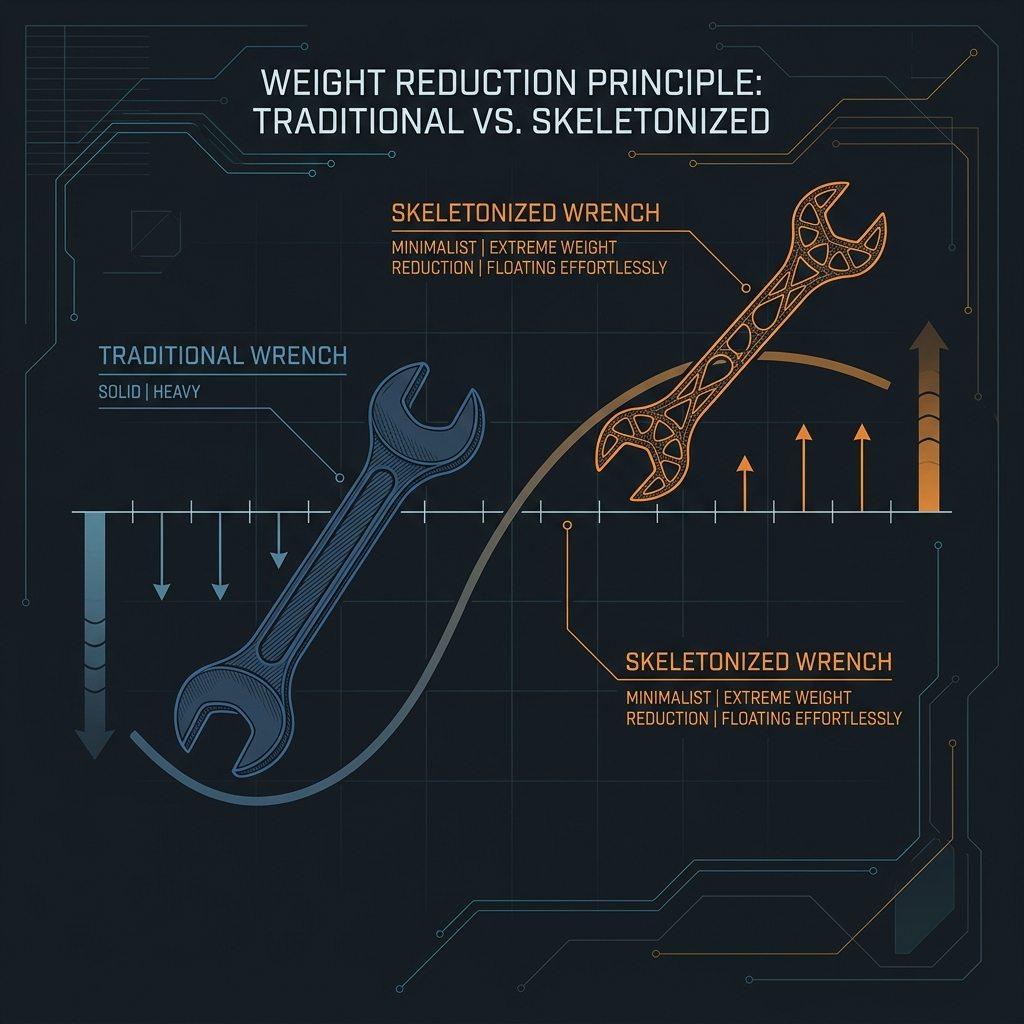
*Note: AI-generated visual representation of the dramatic weight reduction achieved by the skeletonized design.
The Perfect Balance for Motorcycle & EDC
When you are on the trail or the roadside, you need a wrench that won’t flex or snap when dealing with a seized bolt. Standard chrome vanadium tools provide that strength but add significant “dead weight” to your pack. Asahi LIGHTOOL solves this by reducing the weight of their wrenches by up to 55% compared to standard counterparts, without compromising on the industrial-grade strength required for real mechanical work.
Good Design Award Winning Aesthetics
Beyond pure data, these tools look phenomenal. The heavily skeletonized design is so striking that the series won the prestigious Good Design Award in 2023. To put that in perspective for Western riders, this is Japan’s equivalent to the Red Dot Design Award or the IDEA (International Design Excellence Awards), recognizing products that perfectly harmonize form and function. They don’t just function well; they are a mechanical work of art that belongs in any premium EDC loadout.
Meet the Asahi LIGHTOOL Lineup
- Combination Wrenches (LCW/LCWU): The perfect all-rounder. Featuring an open-end and a 12-point box end.
- Double Open-End Spanners (LSX): The ultimate weight-saving option. These are aggressively skeletonized, perfect for tight clearances.
- Double Box Offset Wrenches (LOF): Designed for high-torque applications where a secure fit on the bolt head is mandatory.
- The 3/8″ Ratchet Handle (LVR): A featherweight 72-tooth ratchet mechanism that provides a precise 5-degree swing arc.
(Embedded Video Review: Real user test showing the Lightool in action)
🔬 [Deep Dive] The Science of “Skeleton” Forging
How can a wrench with massive holes and deep recesses be as strong as a solid piece of steel? The answer lies in structural mechanics and Japanese manufacturing precision.
The I-Beam Principle: Removing “Dead Weight”
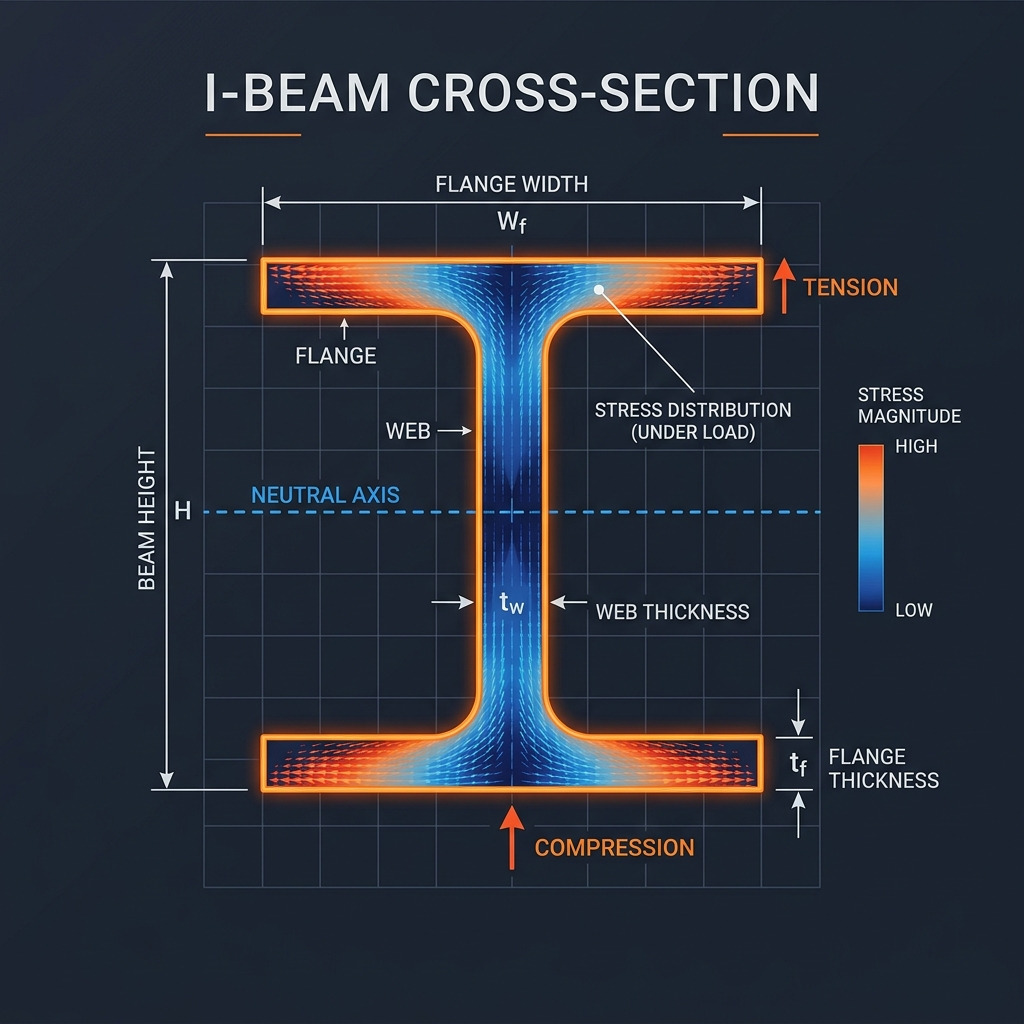
*Note: AI-generated abstract diagram illustrating the physical principles behind the Lightool’s structural strength.
If you look at the cross-section of a LIGHTOOL handle, it resembles an “I-beam” (or H-beam) used in skyscraper construction. In structural engineering, the material in the center (the web) contributes very little to the tool’s resistance against bending. The strength comes from the outer edges (the flanges). By maximizing the moment of inertia and removing the mathematically irrelevant material in the center, Asahi sheds the “dead weight” while maintaining structural integrity.
Hot Forging vs. Machining: Grain Structure Matters
You cannot simply take a standard wrench and drill holes into it; doing so creates stress concentrators that will cause the tool to snap under torque. Asahi uses a hot forging process. This aligns the metal’s internal grain structure with the shape of the recesses and cut-outs, resulting in a significantly tougher tool that easily exceeds strict Japanese Industrial Standards (JIS). JIS is the rigorous national standard of Japan, often considered equivalent to or even stricter than ANSI (American National Standards Institute) or DIN standards for hand tools, ensuring the tool will not deform under extreme torque.
📊 [Deep Dive] Ruthless Data Comparison: Lightool vs. The World
Let’s look at the hard data. How does Asahi Lightool compare against the traditional heavyweights (like Craftsman or Snap-on) and the ultra-premium alternatives?
Weight Comparison Table
The numbers don’t lie. Here is how Asahi’s design impacts real-world weight:
| Wrench Size | Standard Steel Wrench | Asahi LIGHTOOL | Weight Reduction |
|---|---|---|---|
| 8 x 10mm | ~30g | 15g | 50% Lighter |
| 12 x 14mm | ~70g | 50g | 29% Lighter |
| 17 x 19mm | ~120g | 100g | 17% Lighter |
Data source: Manufacturer specifications. Reductions are most dramatic in the smaller, frequently used EDC sizes.
The “Cheater Bar” Test: Do They Flex or Snap?
Standard heavy wrenches are indestructible but are absolute overkill for a portable kit. On the other end, Titanium wrenches are incredibly light but insanely expensive, and often brittle. Asahi Lightool hits the sweet spot. Hardcore ADV motorcycle riders have reported using “cheater bars” (extension pipes) on the larger Lightool sizes to break loose rusted axle nuts. The result? The bolt breaks loose, and the wrench doesn’t bend.
Build Your Ultimate Lightweight Toolkit
Ready to shed some weight from your tool roll? Here are the best places to pick up genuine Asahi LIGHTOOLs for your kit:
- Asahi LIGHTOOL Combination Wrench Set (Metric): The essential starter kit.
- Asahi LIGHTOOL Double Open-End Spanner Set: For the extreme minimalist.
- Asahi LIGHTOOL Double Box Offset Wrench Set: High-torque applications.
- Asahi LIGHTOOL 3/8″ Ratchet Handle: The heart of a lightweight socket set.
FAQs about Asahi Lightool
Q: Are skeletonized wrenches weaker than solid ones?
A: No. Because they are hot-forged and utilize an I-beam structural design, Asahi Lightool wrenches meet or exceed Japanese Industrial Standards (JIS) for strength, making them just as strong as standard solid wrenches for their intended applications.
Q: Where are Asahi tools made?
A: Asahi Metal Industry Co., Ltd. manufactures its tools in Japan, specifically in the Niigata prefecture, an area famous for its high-quality metalworking and forging history.
Q: Are Asahi Lightool wrenches titanium or aluminum?
A: Neither. They are made from high-quality chrome vanadium steel. Their light weight comes entirely from their advanced physical design and forging process, giving you the strength of steel without the cost or brittleness of titanium.
Upgrade Your Entire Kit
If you’re building the ultimate Japanese tool roll, the Asahi LIGHTOOL wrenches are only half of the equation. For socket work, you need a ratchet that matches this level of precision. Ko-ken’s Z-EAL series offers an insanely low-profile head and virtually zero back-drag, making it the perfect companion for tight motorcycle clearances.
👉 Read our Data-Driven Review: Ko-ken Z-EAL 3/8″ Ratchet
And what happens when a rusty bolt head is already completely stripped before you even get your wrench on it? Even the best tools can’t grip a perfectly round, rusted-out screw. That’s where Vampire Tools (engineered by Engineer Inc. in Japan) comes in. Their patented jaw design bites into stripped screws and extracts them when all other methods fail.
👉 Read our Deep Dive: VAMPLIERS Screw Extraction Pliers
By combining Asahi’s extreme weight savings, Ko-ken’s mechanical precision, and Vampliers’ emergency rescue capabilities, you will have an elite, lightweight toolkit that can handle almost any roadside disaster. Ride safe, and keep wrenching.
Disclosure & Editorial Independence: This post contains affiliate links. As an Amazon Associate and affiliate for other networks, we earn from qualifying purchases. However, our editorial content is strictly independent and is never influenced by affiliate partnerships or manufacturers.
Transparency & Accuracy Note: The content in this article was compiled with the assistance of advanced AI to analyze user reviews and historical data. While we strive for accuracy, there may be occasional errors, and product prices/availability are subject to change. Any images marked as "AI Generated" are for illustrative purposes only.
⚠️ Safety Disclaimer: The use of hand tools, power tools, and related equipment can be inherently dangerous. The information provided is for educational purposes only. Always read, understand, and strictly follow the official safety manuals provided by the manufacturer before using any tool.